
What is Sympathetic Detailing?
Sympathetic detailing means that the details should last the lifetime of the roof material.
One of the big selling points of investing in a metal roof is the lifetime of the materials. The metal used in a metal roof is an investment for the next generation, with steel lasting 50-70 years, and copper over 100 years.
Yet it seems that many recently-installed metal roofs aren’t living up to that material lifespan. What gives?
The details give. Or, in modern parlance, the modern details aren’tgiving.
We’re talking about “evolved domestic (US) detailing” versus “sympathetic detailing”.
Evolved domestic detailing is basically a caulk-and-lap-based practice, just made to look high end. Steel milled for roofing in the United States is generally made to be stiff, at least in part to allow for resilience to shipping of pre-formed panels. Using this stiff, domestic steel, the details of a complex roof have to be completed and sealed using chemical sealants. The catch is that this strategy risks premature failure from capillary draw when the sealant eventually fails after only 10-15 years. Have you ever seen a synthetic material that doesn’t disintegrate when left exposed to UV and weather elements for a decade? Me neither.
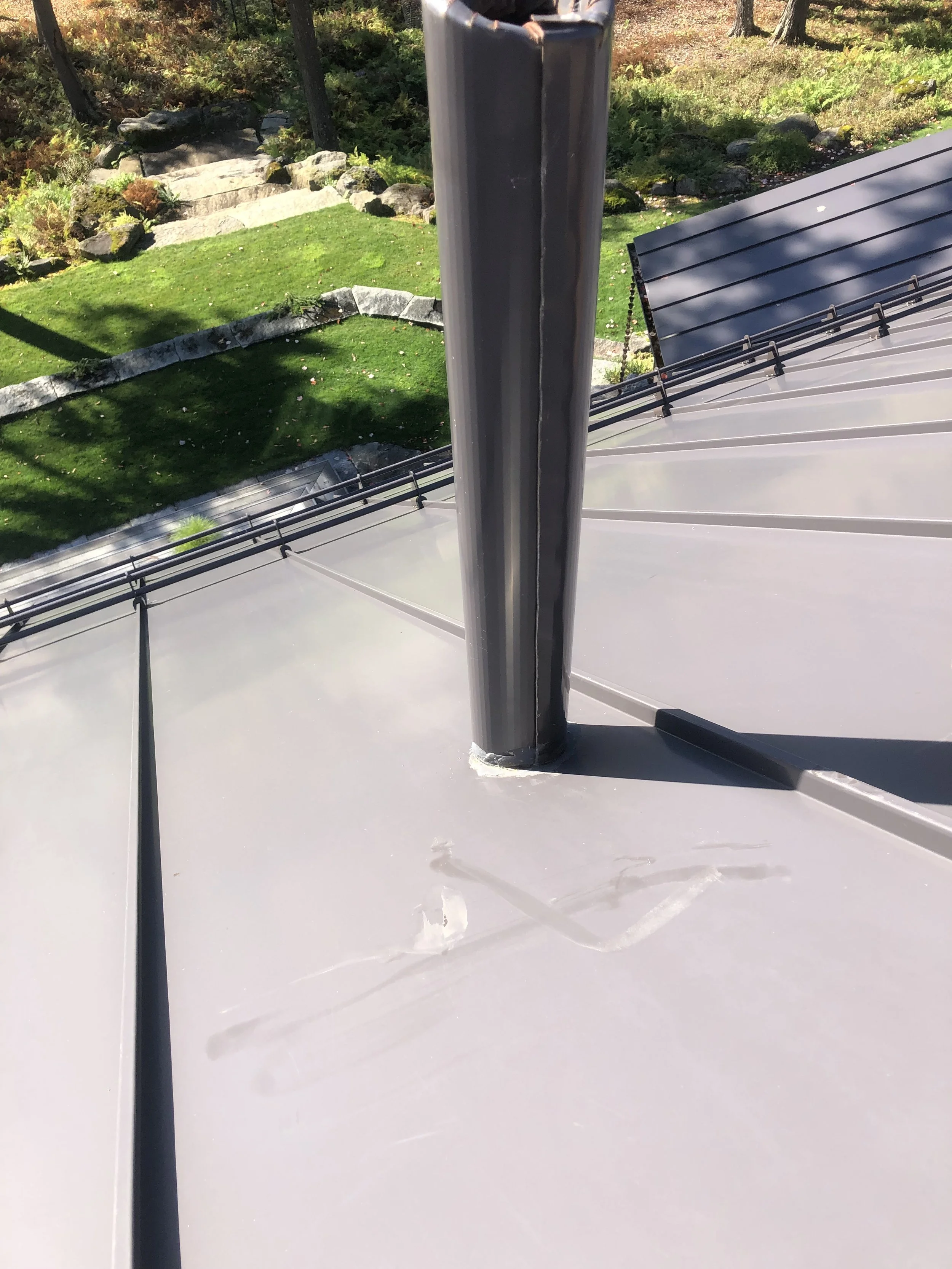
Pipe boot fitted using an "evolved domestic” technique, relying on sealant at the seam.
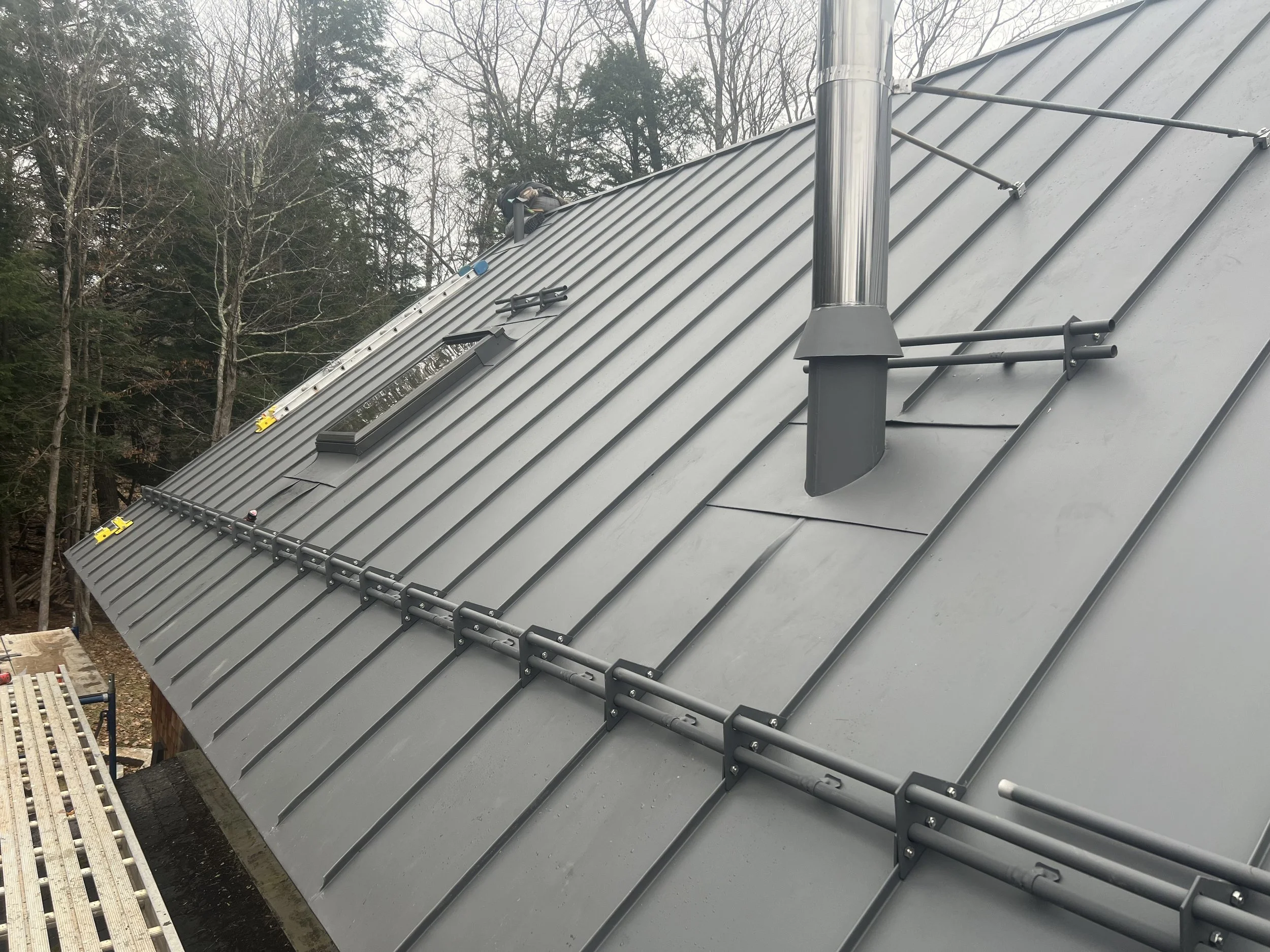
Sympathetic detailing means that the details should last the lifetime of the roof material. This is European-style folded roofing, where the double folded seam is the primary means of waterproofing. Sealant can be folded into the seam in complicated areas as a backup. To achieve this, we need to use softer materials that can withstand the folding. Until recently, this limited us to copper and zinc (because of those tensile characteristics of domestic steel), but there are European-produced materials available that can be more budget-friendly and still support sympathetic details.
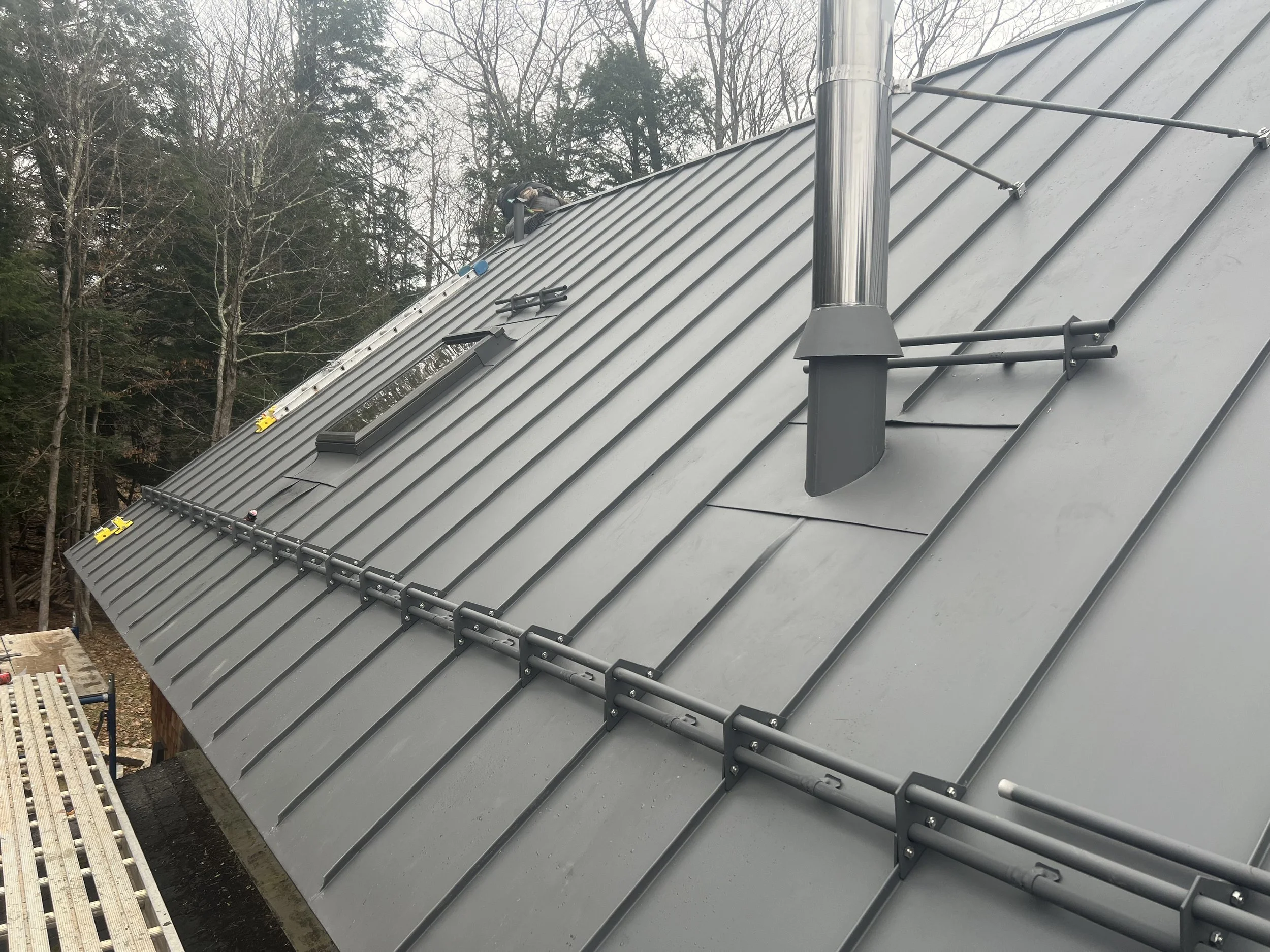
Sympathetic detailing in action. Custom pipe boot and skylight without dependence on chemical sealant.

The Lorax of Houses
“I’m the Lorax, and no one wants to hear it…”
“I’m the Lorax, and no one wants to hear it…”
This is a too-common refrain from Ray after a frustrating assessment or consultation. We call him the Lorax of houses because Ray speaks for the needs of the building. He doesn’t believe in short cuts, and he does believe in physics and building science. Applying these principles constitutes an investment, and is often met with pushback.
Homeowners don’t want to hear that:
Their dream aesthetic design doesn’t make sense in the climate they are building in… even if a ‘design-builder’ or even an architect already drew it for them
Some previous homeowner or worker made shoddy decisions which have put their home at risk
The easiest short-term answer will have long-term consequences
Since these kinds of comments tend to be poorly received in a moment of decision-making, and when someone’s money or home is on the line, we’re going to start writing about them more generally. Maybe this is like therapy, where the concepts and tools need to be introduced when you aren’t in crisis. Then when the crisis comes, you’ll have a better chance of reaching for the right reaction. Or maybe it’s more like therapy for us.
Either way, welcome to our blog.

When we build…
"When we build, let us think that we build forever. Let it not be for present delight nor for present use alone. Let it be such work as our descendants will thank us for; and let us think, as we lay stone on stone, that a time is to come when those stones will be held sacred because our hands have touched them, and that men will say, as they look upon the labor and wrought substance of them, 'See! This our fathers did for us.” ― John Ruskin
“When we build, let us think that we build forever. Let it not be for present delight nor for present use alone. Let it be such work as our descendants will thank us for; and let us think, as we lay stone on stone, that a time is to come when those stones will be held sacred because our hands have touched them, and that men will say, as they look upon the labor and wrought substance of them, 'See! This our fathers did for us.”
― John Ruskin
The past hundred years have been one hell of a ride. The chemical revolution of the 20th century brought a dependency on chemical products to the United States building industry. That, perhaps in coordination with the loss of so much historic Trades knowledge when two generations of young workers were sent off to the World Wars, led to a huge change in the way we build in this country. Now, 80 years later, we are able to see the limited lifespan of the chemical products on which our infrastructure is built (think dry rotting rubber and glue and disintegrating concrete). Yes, we can just replace these materials with the same product, but often, there is already underlying damage done. And often the remnants of those synthetic products have no future but a landfill. Unfortunately we are so deep into a disposable culture that it’s hard to envision breaking the cycle.
For centuries our buildings were built based on physics, rather than chemistry. Carefully shaped and stacked stones, precisely carved joints, and folded metal utilized principles of gravity, friction, and fluid dynamics to keep our structures sound. What if we could go back to building with those time-tested, repairable materials and techniques. We know more than our predecessors from the middle of the 20th century. We know about limited resources, and the global consequences of a throwaway culture. Let’s choose to take Ruskin’s advice and reclaim the skills that will allow us to build with physics again.
Reclaiming these skills would address another consequence of the the loss of trades knowledge; we have also seen a loss in respect for the trades and tradespeople. The societal effects of this cultural swing are probably quite far-reaching (and maybe we’ll save that research project for another blog post), but maybe we can do our part to swing the cultural pendulum back by promoting skilled trades education.
And we know that “just because they used to do it that way, doesn’t make it right”. No need to glorify every aspect of historic practices. But what if skilled craftsmanship and the revival of traditional techniques could be married to revolutionary modern products in a way that actually allows us to build for our descendants? We have no idea how much better we could do.
We want to be a part of a renaissance of trades in the United States.